Mental Health · Anxiety · Nervous System · May 9, 20268 min read
Why Your Anxious Thoughts Won't Stop (and Why It's Not a Thinking Problem)

After reading this you'll know:
- •Anxious thinking is rarely just a thinking problem, and it is rarely just a body problem either
- •Thoughts, attention, uncertainty, sensations, behaviour and context all feed into each other
- •Trying to solve, suppress, or get certainty about the thought often keeps the loop going
- •Working with several parts of the pattern at once tends to help more than reasoning alone
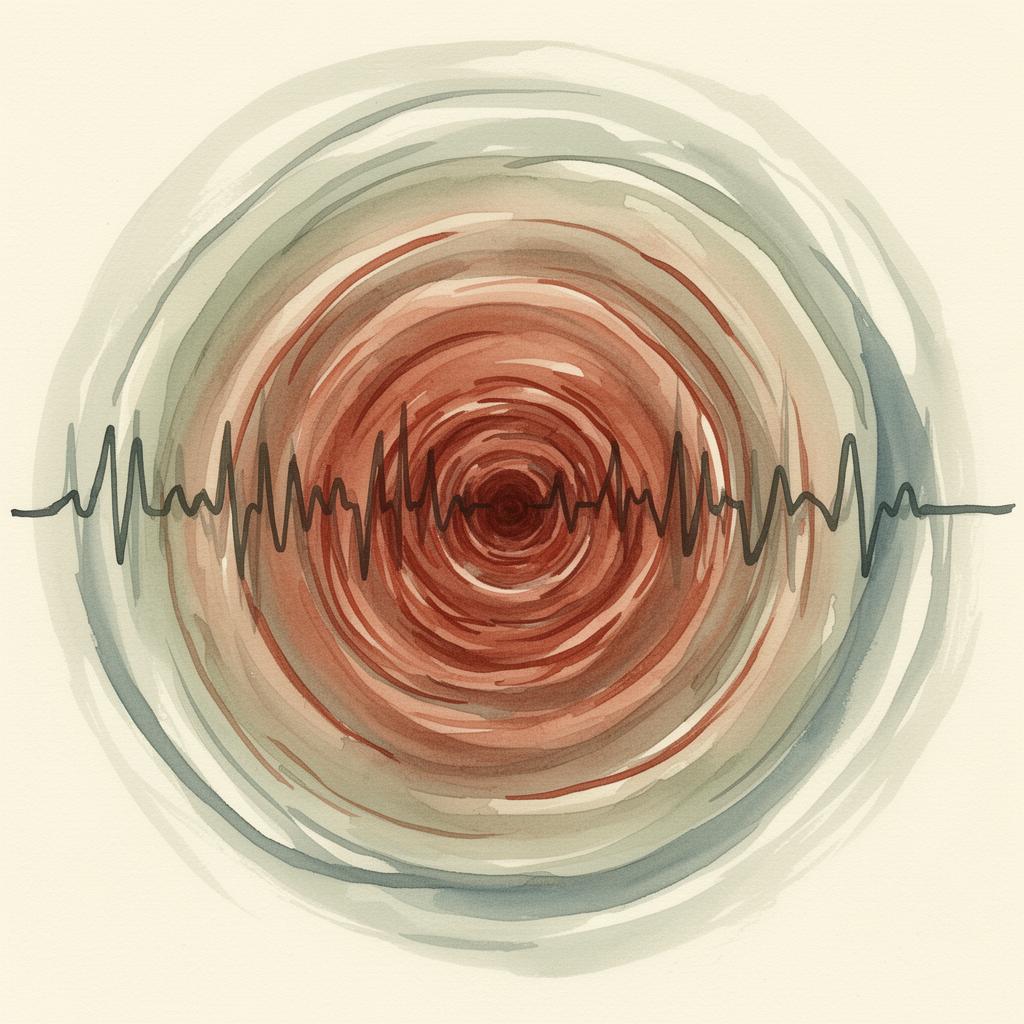
You lie in bed and the same worry plays again. You try to reason with it, distract yourself, breathe, scroll, replay the conversation, plan for the worst. Nothing sticks. The thought keeps coming back, like a song you cannot turn off. If you have ever wondered what is wrong with you, the honest answer is: probably nothing. You are trying to solve something with analysis alone, and analysis is usually only one part of what is keeping the loop alive.
The thought is not always where the loop starts
It feels like the thought comes first. "What if I lose my job", "what if they're upset with me", "what if something is wrong with me". Sometimes it does. But an anxious thought is not always where the cycle begins. Sometimes a bodily sensation, a moment of uncertainty, a memory, a perceived threat, or some other cue is noticed first, and your mind starts trying to make sense of it.
Your brain and body are constantly appraising your situation, much of it outside awareness: heart rate, breath, muscle tension, gut sensations, the tone of someone's voice, an unfinished conversation. When something registers as potentially threatening, attention narrows towards it and your thinking gets recruited to explain and solve it. The thought that arrives ("this must be about work", "this must be about that text she didn't reply to") is part of the pattern, not necessarily its origin.
So the thought may not be the whole story. Thoughts and interpretations can genuinely trigger anxiety and keep it going, and they are also shaped by what your body is doing, where your attention goes, the situation you are in, and how you respond. It is a loop with several entry points, not a one-way street from body to mind.
Why the looping keeps going
Once something is flagged as threatening, the mind does what it is built to do: search for the problem until it feels resolved. That is genuinely useful when the threat is concrete and solvable. It works much less well when what you are trying to resolve is uncertainty itself, or a vague uneasy feeling in your chest at 11pm. When what you're trying to resolve is uncertainty itself, thinking often cannot provide the certainty you're looking for, so the search can keep going.
Researchers call this pattern perseverative cognition, the umbrella term covering both worry (future-focused) and rumination (past-focused). Research on worry and rumination suggests that persistent cognitive stress can be associated with ongoing physiological stress responses, although findings on specific stress hormones such as cortisol are not completely consistent. What is consistent is the link with anxiety, low mood, poor sleep, and difficulty switching off.
In other words: the loop is not simply a sign that you are overthinking. It is a sign that something in the pattern is unresolved, and your mind is trying, faithfully, to help.
Why "just stop thinking about it" does not work
There is a classic psychology experiment: don't think about a white bear. Most people immediately think about a white bear, and often more than people who were never given the instruction. Deliberate suppression tends to backfire, especially when you are already activated. Trying harder makes it louder.
The same happens with anxious thoughts. Telling yourself "stop being anxious", "this is irrational", "other people have real problems" adds a layer of self-criticism and effort on top of the anxiety. The urgency goes up, the mind produces more material, and the loop tightens.
This is also why reassurance often gives only temporary relief. You may fully agree, intellectually, that the plane is statistically safe, or that the email is fine, or that your partner is not actually angry, and still feel it in your chest. Understanding something is not the same as no longer reacting to it.
What tends to happen when anxiety ramps up
When anxiety builds, several things often shift together:
- Attention narrows towards possible threat, and ambiguous things get read as more dangerous than they are.
- Thinking becomes more rigid and less able to hold perspective, nuance, or alternatives.
- The body mobilises: faster heart rate, tighter muscles, shallower breathing, restlessness or a heavy stillness.
- Behaviour changes: checking, avoiding, seeking reassurance, mentally rehearsing. These bring short-term relief and usually keep the pattern going.
From the inside, this feels like "I just can't stop thinking". Seen as a whole, it is a system in which thoughts, sensations, attention and behaviour are all reinforcing each other.
Your body can be part of the loop
Anxiety is not only something that happens in your thoughts. Bodily sensations, thoughts, attention, emotions, memories, expectations and context can all influence one another. Sometimes you notice a racing heart or a tight chest and start wondering what it means. Sometimes a worrying thought comes first and your body responds to it. Often the two reinforce each other, which is one reason anxiety can be so hard to think your way out of.
The same racing heart can be read as excitement before a date, nerves before a presentation, or dread at 3am. What you make of the sensation matters, and what you make of it is shaped by memory, context, expectation, and what you do next.
This also explains something many people quietly suspect about themselves: anxious thoughts can feel slightly "off topic". You are worrying about the email, but the intensity is out of proportion. You are spiralling about a friendship you know, somewhere, is fine. That mismatch usually means the content of the thought is not the only thing driving the feeling.
Because anxious thoughts and bodily responses can reinforce each other, working with the body can sometimes create another way into the cycle. Sometimes the thoughts become easier to work with when the body is less activated. And sometimes changing how you relate to the thoughts helps the body settle too.
Why this is useful to know
If anxiety were purely a thinking error, the only way out would be to become a more clever thinker, which most anxious people have already tried, exhaustively. Because the pattern has several moving parts, there are several places to work: what you pay attention to, how you relate to uncertainty, what you do when the feeling arrives, and how you help your body settle.
Understanding what you think is important, but understanding alone does not always change how an experience feels. Different approaches can work with different parts of the pattern, including thoughts, emotions, bodily responses, attention and behaviour. Sometimes changing the way you relate to a thought helps. Sometimes working with the body's response helps. Often, both are useful.
What can help loosen the loop
None of these are magic tricks, and none are about forcing calm. They are ways of stepping into the loop at a different point, so the thought no longer has to be won.
- Slow, comfortable breathing. Slow, comfortable breathing can help reduce physiological arousal for some people. Try making the exhale slightly longer than the inhale, without forcing your breath. If slowing your breath makes you feel worse, let it go and try something else.
- Grounding through the senses. Feet on the floor, weight in the chair, naming what you can see and hear. Cool water on your face or holding something cold is an optional grounding strategy that some people find helpful in the moment; it is not a proven treatment for anxiety.
- Move, gently. A short walk, shaking out your arms, stretching, slow yoga. Movement gives a mobilised body somewhere to go, and physical activity has good evidence for anxiety and mood over time.
- Describe the experience instead of debating it. "Tight chest. Hot face. Buzzing hands. A thought about the email." Research on affect labelling suggests that putting an emotional or bodily experience into words can sometimes change how we experience it, creating a little more distance from the immediate reaction.
- Change what you do, not just what you think. Delaying the reassurance-seeking, not re-reading the message, letting the uncertainty sit for ten minutes. This is where the loop actually loses fuel.
- Reach for safe connection. A short message to someone who feels safe, a voice note, sitting near a calm person. Safe social connection can help reduce distress and make difficult moments feel more manageable.
Where EFT fits in
EFT (Emotional Freedom Techniques) is one practical option, and it is often useful for exactly the situation this article describes: you understand your anxious thought intellectually, and you still feel it strongly in your body.
Research on Emotional Freedom Techniques has found meaningful reductions in anxiety and psychological stress. A growing body of research suggests that EFT can be helpful across a range of psychological difficulties, including anxiety, stress, depression and PTSD, with studies also reporting improvements in physiological stress markers.
What research supports: Clinical EFT combines cognitive and exposure elements with acupoint stimulation (tapping), and clinical research has found reductions in anxiety and stress following EFT.
If you'd like to learn it properly, in a way that's made for this kind of looping, my EFT course is live now for just €7. It suits some people better than others, and it is not a replacement for professional treatment when you need it.
And where CBT fits in
CBT is one of the best-studied psychological treatments for anxiety, and it can be very effective. It works directly with the thoughts, interpretations and behaviours that keep anxiety going, and for many people that is exactly what is needed.
But no single approach works equally well for everyone. Different approaches may be useful depending on the person, the problem, and what is maintaining the pattern. This is not a contest between methods: anxiety is one complex experience with cognitive, emotional, bodily, behavioural and situational parts, and different approaches simply enter it from different sides.
A small reframe for the next loop
When the next anxious thought arrives, try widening the question. Instead of only asking "is this true?", also ask "what else is going on right now, in my body, my attention, and what I'm about to do?". Then choose one small kind action: a slower breath, feet on the floor, a walk, a message to someone safe. The thought does not have to be solved for the loop to loosen.
💛 When to consider professional support
Some anxious thinking is part of being human. But if the loops are most of your day, keeping you from sleep, work, or the people you love, or tipping into panic, intrusive thoughts, or hopelessness, please consider working with a trauma-informed therapist or your GP. Anxiety is very treatable, and you do not have to figure this out alone.
A gentler way to read your own mind
Your anxious thoughts do not mean that you are broken, or that you are simply "overthinking". Anxiety can involve an interaction between thoughts, emotions, bodily responses, attention, behaviour and context. Understanding that pattern gives you more options.
Sometimes that means changing the way you relate to a thought. Sometimes it means working with the body's response. Often it means addressing both.
You do not have to think your way out of everything.
Read this next